
Beyond Behaviorism: The Worldviews Behavior Analysts Rarely See


Dr. Scott Frasard is an autistic autism advocate who is a published author and an outspoken critic of operant conditioning approaches to change natural autistic behaviors to meet neuronormative social expectations.
Introduction
Behaviorism is often presented as a scientific approach to understanding learning and behavior. In many professional settings, particularly within Applied Behavior Analysis (ABA), it can feel less like one perspective among many and more like the default framework through which all learning should be understood. Yet behaviorism is not a neutral foundation beneath every educational, psychological, or developmental theory. It is a worldview; a coherent and influential one, but a worldview, nonetheless.
Recognizing this difference is important because many behavior analysts receive extensive training in behaviorist theory while having comparatively little or no exposure to other traditions that have shaped how educators, psychologists, disability scholars, sociologists, and communities understand learning and human development. Constructivist, humanistic, sociocultural, critical, decolonial, and neurodiversity-affirming perspectives often begin with very different assumptions about what learning is, what support should look like, and what it means for a person to thrive.
The purpose of this article is not to dismiss behavior analysts or deny that behaviorist approaches can produce observable outcomes. Rather, it is to challenge a common assumption: that behaviorism is the only rigorous, evidence-based, or intellectually serious way to understand learning and support. While behaviorist methods have contributed valuable insights and practical tools, they do not exhaust the range of legitimate ways to study human development, learning, or behavior. When one framework becomes so dominant that alternatives are rarely examined, important questions can disappear from view. This can limit both scientific inquiry and professional practice by narrowing the kinds of evidence, experiences, and explanations that are considered worthy of attention.
Behavior is only one aspect of human experience. When observable behavior becomes the primary unit of concern, practitioners can overlook the things that behavior alone cannot fully explain meaning, context, cognition, culture, relationships, power, identity, agency, and dignity. The result is not merely a difference in technique. It is a difference in how we define problems, how we understand learners, and what kinds of futures we imagine are possible for them.
The sections that follow explore what happens when the same challenges commonly addressed by ABA are viewed through other educational and developmental traditions. The goal is not to declare a single winner among competing theories, but to make something often invisible visible: behaviorism is one lens among many, and what we see depends greatly on the lens we choose.
The Behaviorist Lens: Coherent, but Incomplete
Through behaviorist lens, behaviorism offers a clear and internally consistent account of learning and behavior. By focusing on observable actions and the environmental contingencies that shape them, behaviorists demonstrated how reinforcement, punishment, and conditioning can reliably influence behavior across a wide range of contexts. This emphasis on measurable outcomes helped establish psychology as a more rigorous empirical science and produced practical interventions that remain influential in education, therapy, organizational management, and behavior change programs.
The behaviorist framework is incomplete as a comprehensive theory of human cognition. Its methodological commitment to observable behavior often leaves little room for explaining internal mental processes such as reasoning, planning, memory, language comprehension, and problem-solving. While behaviorist models can describe patterns of behavior and the conditions under which they occur, they struggle to account for how individuals process information, generate novel responses, or act in ways that are not directly traceable to reinforcement histories.
The limitations of a purely behaviorist approach become especially apparent in domains such as language acquisition and complex decision-making, where observable behavior alone cannot fully explain human performance. Researchers found that many aspects of learning, reasoning, and problem-solving seemed to involve internal processes that could not be adequately accounted for through stimulus-response associations alone. These challenges contributed to the rise of cognitive psychology, which sought to investigate the mental mechanisms underlying behavior rather than treating them as inaccessible or irrelevant. By focusing on processes such as memory, attention, perception, and information processing, cognitive psychologists aimed to develop a more comprehensive understanding of how people think and act.
As a result, behaviorism is best understood not as a failed theory but as a powerful, but partial, perspective. It provides valuable tools for analyzing how environments shape behavior, particularly through mechanisms such as reinforcement, punishment, and conditioning that continue to inform research and practical applications today. At the same time, its emphasis on observable behavior limits its ability to explain how people form mental representations, solve novel problems, or engage in reflective reasoning. For this reason, behaviorism is often viewed as one component of a broader understanding of human psychology, contributing selective insights while leaving questions about internal cognition, representation, and conscious thought to other theoretical frameworks.
The Five ABA Targets Are Not Neutral Categories
ABA programs are often organized around a familiar set of developmental and behavioral priorities. Across clinics, schools, and home-based services, practitioners commonly focus on five broad areas:
Challenging or “problem” behaviors
Communication
Social skills
Adaptive and daily living skills
Learning readiness and school participation
At first glance, these categories appear straightforward and value neutral. They seem to describe practical areas in which a child may need support; however, the way these categories are defined, measured, and prioritized is never entirely objective. Each category reflects underlying assumptions about what counts as appropriate behavior, effective communication, successful learning, independence, and social participation.
To illustrate underlying assumptions, a behavior may be labeled “challenging” because it disrupts a classroom routine, creates difficulties for caregivers, or violates social expectations. A communication goal may prioritize spoken language over other forms of expression. Social skills programs may emphasize conformity to prevailing social norms rather than mutual understanding or authentic connection. Adaptive skills targets often reflect cultural expectations about independence and self-sufficiency. Even learning readiness goals can be shaped by assumptions about how children should attend, participate, and behave in educational settings.
These assumptions are not necessarily malicious, but they are important because they influence what becomes a treatment target and what does not. They guide clinical priorities by determining which behaviors are identified as needing intervention and which are accepted as variations. In doing so, they also affect how abilities are evaluated, shaping whether certain traits are framed as deficits or differences. Ultimately, these assumptions play a role in defining what outcomes are considered desirable, influencing both the goals set in treatment and the measures used to assess progress.
This raises a fundamental question: who gets to define the problem, and whose comfort, convenience, or priorities determine the goal? Is a behavior problematic because it harms the individual, because it interferes with learning, because it creates challenges for others, or simply because it departs from expected norms? These distinctions are not merely theoretical; they shape how behaviors are interpreted in practice and influence whether the focus is on support, accommodation, or correction. The answer matters, because different answers lead to different interventions and different judgments about success, as well as different expectations for change and responsibility.
These five target areas therefore cannot be understood as purely technical categories. They are interpreted through broader beliefs about development, education, disability, and human flourishing, which shape how goals are defined and what counts as meaningful progress. Such underlying assumptions influence the selection of methods, the prioritization of certain skills over others, and the ways in which outcomes are evaluated. As a result, the same issue can look very different depending on the learning tradition or theoretical framework being applied, leading to variations in both practice and interpretation across contexts.
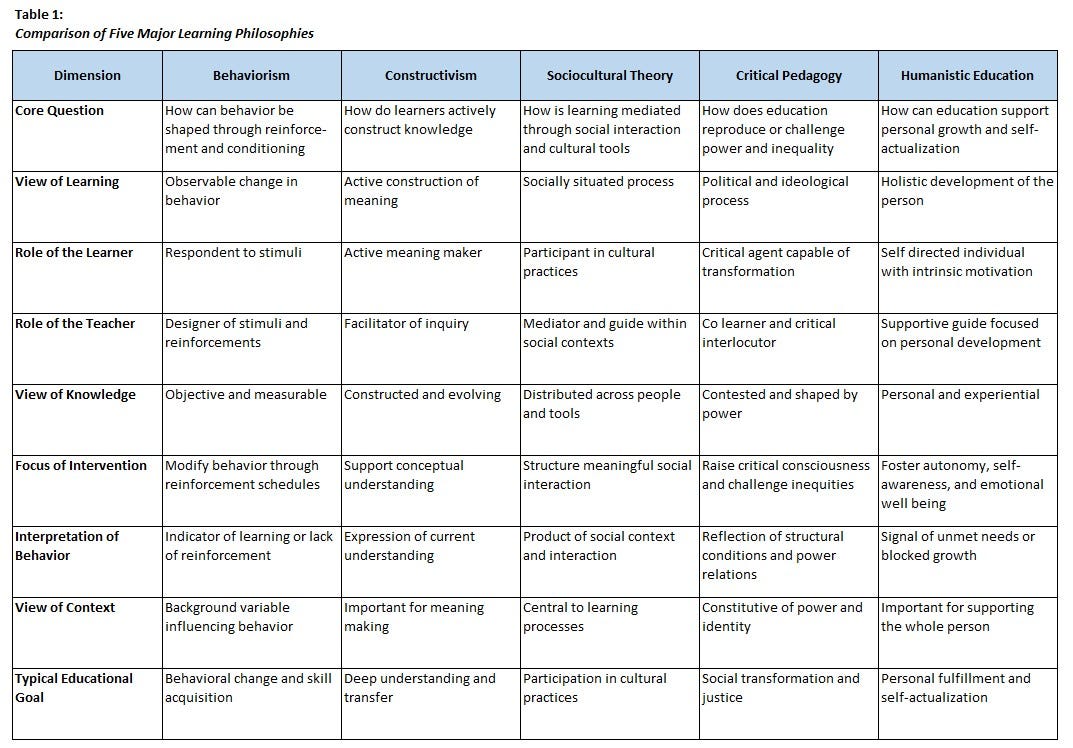
Table 1 below illustrates this point. It summarizes how meaning, significance, and intervention goals can shift dramatically when viewed through different educational and psychological traditions.
A Worldview Comparison Beyond Behaviorism
When different educational traditions are placed in dialogue, they do not simply offer alternative techniques; they ask fundamentally different questions about what is happening in a learning environment. These perspectives do not merely add layers to a single framework; they reframe the problem itself. What counts as learning, what counts as knowledge, and what counts as success all shift depending on which voice is foregrounded. A behaviorist might interpret a student’s actions as evidence of reinforcement history, while a constructivist might see the same actions as expressions of evolving understanding. A sociocultural theorist might locate the explanation in patterns of participation and access to cultural tools, while a critical pedagogue might interpret them as reflections of structural inequities. A humanistic educator might instead ask what unmet needs or blocked forms of growth are being expressed.
Seen this way, educational theory becomes less about choosing the correct model and more about recognizing how each perspective illuminates different aspects of the same situation. The conversation across these worldviews reveals that no single lens can fully account for the complexity of learning. Instead, each tradition brings into focus particular dimensions, to include behavior, meaning, context, power, identity, and development, which together form a richer, more nuanced understanding of educational practice.
The table below should be read as an interpretive comparison rather than a definitive taxonomy. It does not attempt to exhaust the complexity of each tradition, nor does it claim that any framework is internally uniform. Instead, it highlights how different traditions begin from distinct assumptions about what learning is, what counts as knowledge, and how educational problems should be understood. In doing so, it makes visible that behaviorism is one lens among many, not a universal baseline.
Different Questions Create Different Supports
Behaviorism asks what function a behavior serves and how it can be changed. It assumes the problem is visible, measurable, and correctable; often without asking whether it should be changed at all. Behavior is treated as an observable output shaped through reinforcement, punishment, and environmental manipulation. Practitioners identify antecedents and consequences, isolate variables, and engineer conditions to increase or decrease responses. This approach offers powerful tools for skill acquisition, especially in structured settings. Yet its focus on what can be seen and counted almost certainly overlooks internal experiences, context, and ethics. A student’s refusal, for example, may be treated as noncompliance rather than communication, protest, or self-protection.
Constructivist traditions ask what the learner is trying to understand. They shift the focus from compliance to meaning making. Rooted in theorists like Piaget and Vygotsky, constructivism views learning as an active process of building knowledge through interaction. Errors are seen as insight into understanding, not failures. Instruction aims to design experiences that extend thinking rather than impose correct responses. A learner who resists a task may be facing confusion, mismatch, or lack of relevance. The practitioner’s role is to interpret and support to scaffold understanding and connecting new ideas to prior knowledge.
Humanistic traditions ask what the learner needs to feel safe, valued, and whole. They reject treating distress as defiance and view unmet needs as signals, not failures. Influenced by Maslow and Rogers, this perspective centers emotional and relational dimensions of learning. Growth depends on psychological safety, and behavior reflects attempts to meet needs for belonging, autonomy, and competence. Rather than controlling behavior, the goal is to create environments where individuals can thrive. A student who withdraws or acts out is signaling something essential is missing. The practitioner listens, builds trust, and responds with empathy.
Critical and social justice traditions ask who holds power and who benefits from defining a problem. They reveal how interventions can reinforce inequity. Drawing from critical pedagogy and sociocultural theory, these perspectives examine whose norms are enforced and whose voices are marginalized. Behavior labeled disruptive may reflect cultural identity or resistance to injustice. By reframing the issue, attention shifts from individual deficits to systemic dynamics. Practitioners are called to examine their role within power structures and advocate for more equitable practices.
Culturally sustaining and decolonial traditions ask whose norms are centered and whose ways of being are erased. They challenge the idea that dominant culture is neutral. These perspectives emphasize honoring diverse linguistic, cultural, and epistemological practices. Rather than expecting assimilation, they create space for multiple ways of knowing. This involves examining curricula, assessments, and expectations that may privilege some groups over others. Behavior cannot be understood apart from cultural context. Practitioners engage respectfully with that context and design environments that affirm identity.
Neurodiversity-affirming pedagogy asks what support preserves agency, access, regulation, communication, and identity. It rejects the idea that difference must be normalized. Grounded in the neurodiversity movement, it views neurological differences as natural variations. It emphasizes accommodating diverse needs and respecting preferred ways of interacting. Behaviors often targeted for reduction may instead be strategies for regulation or expression. The goal is not to make individuals appear typical, but to support full and authentic participation. Practitioners collaborate with learners, prioritize consent and dignity, and design supports that enhance identity.
Taken together, these perspectives illustrate a key claim: different worldviews do not merely produce different interventions. They produce different definitions of the learner, the problem, the goal, and the ethical responsibility of the practitioner. And if you are not interrogating your questions, you are already choosing a side.
The Ethical Danger of Mistaking Behavior Change for Support
Reducing or changing behavior is not the same as reducing distress. When outward expressions such as stimming, avoidance, or protest are suppressed, the underlying causes, such as sensory overload, anxiety, confusion, or unmet needs, `often remain unaddressed. In many cases, the distress is simply driven inward, becoming less visible but more entrenched. What appears to be improvement may instead be a shift from observable struggle to silent suffering, which is far more difficult to detect and respond to.
Increasing compliance is not the same as increasing agency. A learner who follows instructions without resistance may be perceived as successful, yet this compliance can come at the cost of autonomy and self-determination. When individuals are conditioned to prioritize external demands over their own internal signals, they may lose the ability, or the perceived permission, to advocate for themselves. True support fosters the capacity to make choices, express preferences, and assert boundaries, not merely to comply with expectations.
Teaching communication is not the same as honoring voice. Providing tools such as speech, sign, or AAC systems is only meaningful if the individual’s expressions are genuinely listened to and respected. Communication becomes hollow when it is shaped primarily to meet others’ expectations rather than to convey authentic thoughts, feelings, and needs. Honoring voice requires not just enabling expression, but also responding to it with seriousness, flexibility, and respect, even when what is communicated challenges the status quo.
Teaching social skills is not the same as supporting belonging. Instruction in eye contact, conversational turn-taking, or normative social behaviors may help individuals navigate certain environments, but it does not guarantee that they feel accepted or valued. Belonging emerges from mutual understanding and inclusion, not from conformity to prescribed norms. When social skills training prioritizes fitting in over being understood, it risks reinforcing the idea that one must change to be worthy of connection.
Teaching independence is not the same as supporting flourishing. Independence is often framed as the ultimate goal, yet it often subjugates the importance of interdependence, community, and support systems. A person may perform tasks alone while still lacking meaningful engagement, purpose, or well-being. Flourishing involves more than self-sufficiency; it encompasses emotional health, meaningful relationships, and the ability to live a life aligned with one’s values and needs.
Preparing a learner for participation is not the same as making an environment accessible. Efforts frequently focus on adapting the individual to fit existing structures rather than questioning whether those structures are equitable or inclusive. True accessibility requires modifying environments, expectations, and systems so that diverse ways of being are accommodated. Without this shift, preparation becomes a one-sided burden placed on the learner, rather than a shared responsibility to create inclusive spaces.
Behavior change can look successful to observers while still being harmful to the person. External metrics, such as reduced disruptions, increased task completion, smoother interactions, can create the illusion of progress, yet they fail to capture the internal experience of the individual. When success is defined solely by observable outcomes, it risks overlooking the emotional, psychological, and ethical dimensions of support. The most concerning outcomes are those that appear effective on the surface while quietly undermining well-being, dignity, and selfhood.
Conclusion
Behaviorism is but one learning theory; not the whole map of learning, teaching, support, or human development. It is still only a lens that sharpens certain patterns while blurring others. When we mistake that lens for the entire learning landscape, we reduce complex human lives to what can be counted, measured, and controlled, and we lose sight of meaning, context, and lived experience.
If ABA practitioners have only studied behaviorism deeply, then they are not seeing the whole person. They are seeing a curated slice of humanity: responses without histories, actions without narratives, compliance without consent. This is not a neutral limitation; it is a profound blind spot that shapes how people are understood, treated, and ultimately valued.
Intellectual humility demands more. It requires engaging with other traditions with the same seriousness often devoted to Skinner, reinforcement, and operant conditioning, not as a token gesture, but as a genuine expansion of what counts as knowledge, evidence, and expertise. This work must be approached with curiosity, openness, and a willingness to encounter perspectives that challenge one’s existing beliefs. Yet exposure alone is not enough. Intellectual humility also requires reflecting on those perspectives, examining how they shape one’s worldview, and remaining willing to revise that worldview when warranted.
The world beyond behaviorism is not anti-science. It is broader, more contextual, more humane, and more honest about power. It asks harder questions about who defines “appropriate” behavior, whose goals are prioritized, and how systems shape what is possible for individuals.
Behavior is visible, but visibility is not the same as truth.
Thank you for taking the time to read this post. If you enjoyed it, please do click LIKE and click SHARE to share it with your network. Be sure to check out my books, available in both paperback and Kindle”
A Reflective Question to Ponder: 1,200+ Questions on Autism to Foster Dialogue
Autism Advocacy Unleashed: A Socratic Journey to Social Justice
Burning The Behaviorist Blueprint: Exposing and Dismantling the ABA Empire
If my advocacy or writing has sparked reflection or helped you see autism differently, and you’d like to offer a small thank-you, you can buy me a coffee here:
Thank you!
Hi Scott: Keep up the great work.
Honestly. I could not have said it better. (I hope that means something.)
However, what I keep experiencing at substack is a silence when I bring up and discuss what I have concluded are the major variables that produce (automatically) many of the observable characteristics of what we currently call ASD (and its spectrum).
High sensory amplification, alone, is challenging enough to produce workarounds that seem non-average. Add in an over-amped anterior cingulate cortex data conflict monitor (often called error detection) and the challenges become huge. Amp + Amp. Get it? Huge multipliers.
Just because the challenges are often non-observable does not mean they are not there. Unless we consider the behavioral output (work arounds) that are needed for that sensory processing environment, we are going to create mythology.
The data conflict monitoring part of the equation is getting way too little press. The sensory sensitivities gets the press, as it should.
But the amped up data conflict recognition which produces highly accurate and amped-up pattern/dispattern recognition (connecting the dots, etc.), huge discrepancy detection capabilities (hypocrisy, justice, fairness, lying, dishonesty, and irrational or illogical thinking, etc.) gets very little press. I could say more.
You can check my post about "Wouldn't it be nice if hypocrisy made people sick?
Data conflict monitoring is no little contribution to survival (and likely to what we consider "civilization"). But, it goes even further since almost every piece of data our brain is processing has a conflict resolution need.
Think about how even smooth muscle movements depend on or are highly influenced by data conflict monitoring. I could say more, but you may already know that muscle movements depend on opposing sets of muscle fibers to be smooth – flexors and extensors coordinating different and "opposite" signaling to produce smoothness.
That coordination of opposing forces can be pictured by thinking about the difference between closing a door with one hand or closing it with two – one hand on the handle pulling lightly and in coordination with the other hand pushing lightly in coordination with pulling force. Closing can be done so smoothly and accurately even at high speed that it is barely perceptible to hearing. Closing the same door with one hand that smoothly is almost impossible unless you slow it way, way down.
More of that discussion at my substack. Bottom line? It looks like all kinds of behaviors are influenced by data conflict resolution needs. No movement, for instance, is perfectly data conflict free.
No movement is a perfect coordination of the extensors and flexors, if you measure it superaccurately.
In other words, no movement, if measured accurately enough, does not have some potential data conflict signal. If your conflict monitor is at the right amp, the resolution of data conflict will be different (less signal, less need) – likely less hesitation (to a point).
Consider stuttering, for a moment. Think in terms of noticeable vs not so noticeable. Stuttering as a speech adaptation, in my world, is highly related to data conflict resolution needs ("pause for the cause"). At baseline, such data conflict resolution needs are a given and are automatic.
The vulnerability is built in. How it gets challenged varies. Stuttering, in its traditional scientific definition is much more prevalent in currently-called ASD.
High data loads are known to create higher levels of stuttering. In other words, in addition to the baseline high general sensory sensitivity plus high conflict monitoring the "hesitation" may be more observable (frequent or intense or both). I hope this makes sense.
I have been scouring the lit on this issue for a couple of years now, trying to come up with hypotheses that help to call out the major in-built variables for the expression of currently-called ASD characteristics.
Now, imagine that the manifestation of so-called stuttering can take place in any system that requires smooth operation and average data conflict monitoring.
Ummm.. I can barely use the terms autistic and disorder without gagging, since what creates the major characteristics for the so-called diagnosis cannot logically be called a disorder. A difference, maybe a type, but not without huge upsides.
I could name a number of so-called ASD traits necessary for survival of self and tribe. So called ASDers would likley not have been the greatest warriors. However, they would have been the best sentinels, poison tasters, hypocrisy detectors, trackers, navigators, map makers, judges, and analysts, among other things.
"Symptoms" -- a word that should be ditched by scientists, especially, since it implies a disorder. *His/her symptoms are _ _ _* sounds and means something far different and way more biasing than *His/her "characteristics are" _ _ _ *
I vote for a different understanding. We all are highly influenced by certain baseline physiological defaults that have both an upside and a downside. If so-called ASD mechanisms are highly responsible for the mix of types of humans that have survived, there is no solid scientific evidence for calling those types "disordered."
What that all means for assisting those who may be on the spectrum with clear high baseline data conflict monitoring is up for grabs. Behavioralism seems quite out of place in such a setting.
Identifying and teaching about mechanisms that are, well, not easily modified by "training" might be important. Depathologizing? Vote yes! Educating the so-called majority braintypes? Vote yes! So they can change and adapt to the many variations of the brain without always trying to "shape it."