
When a Behavior Analyst Calls an Autistic Person a Fraud

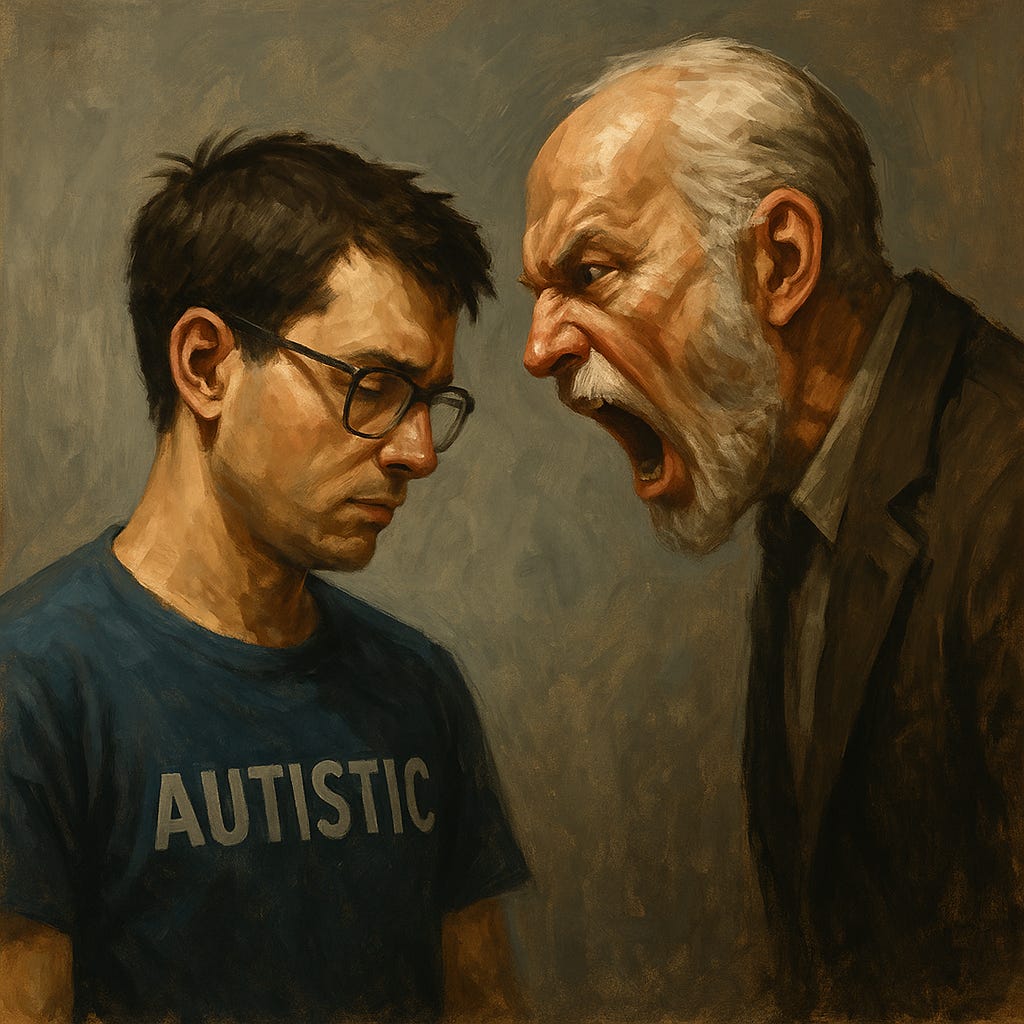
Dr. Scott Frasard is an autistic autism advocate who is a published author and an outspoken critic of operant conditioning approaches to change natural autistic behaviors to meet neuronormative social expectations.
What unfolded in a recent public exchange with an applied behavior analysis (ABA) practitioner was not a debate, not a misunderstanding, and not a clash of perspectives. It was the culmination of a long dialogue thread that began with a simple question and escalated into one of the most overt demonstrations of professional hostility I have encountered. In that exchange the practitioner repeatedly reframed my autistic adult identity as an operant behavior to be analyzed, ignored my assertion that I was formally identified by a psychologist, dismissed my lived experience as a misunderstanding of science, and insisted that only individuals who fit Kanner’s 1943 autism prototype are legitimately autistic. As the conversation progressed, he escalated further, ultimately asserting that my autistic identity was “mislabeling at best” and “deliberate fraud at worst.”
For readers unfamiliar with the background, the full exchange is preserved in this LinkedIn chat. It includes the practitioner’s repeated claims that adults who are independent, verbal, and professionally successful cannot be autistic, his insistence that the word “autistic” should only apply to children described in a clinical paper from more than eighty years ago, and his increasingly hostile attempts to assert sole ownership over the definition of autism. This progression is essential context because it demonstrates the shift from theoretical framing to personal attack and identity erasure.
It is important to state clearly that this individual does not represent all behavior analysts. Many in the field are thoughtful, ethical, and committed to growth. But while this example is extreme, it is not isolated. I’ve personally observed variations of this pattern appear regularly in exchanges between autistic adults and ABA practitioners who cling to outdated models and resist acknowledging adult autistic perspectives. What makes this case distinct is the degree of explicitness. The gatekeeping, the discrimination, and the personal hostility were fully visible and left no ambiguity.
What this individual expressed was not science. It was not clinical judgment. It was not even sincere philosophical disagreement. It was a full-scale collapse of the Behavior Analyst Certification Board (BACB) professional ethics.
A Clear Violation of the BACB Ethics Code
The BACB Ethics Code for Behavior Analysts (2024) articulates its practitioner conduct requirements and establishes a framework intended to protect clients, safeguard the public, and maintain the credibility of the profession. These standards are the foundation upon which trust in behavior analysts is built. They exist to theoretically ensure that those who wield professional authority do so with humility, responsibility, and a deep respect for the individuals and communities they serve. When a practitioner publicly disregards these obligations, it does not merely reflect a lapse in judgment. It signals a fundamental departure from the ethical commitments that define responsible practice. The conduct displayed in this exchange violates multiple actual, published standards, not interpretations or extrapolations but the literal text of the Code. Below are the relevant sections as written in the 2024 document you provided.
Core Principles Section
Behavior analysts should “treat others with compassion, dignity, and respect” and “behave with integrity.”
Attacking an autistic adult’s identity, accusing them of fraud, or implying they are a “myth” violates these foundational expectations before one even reaches the numbered standards.
Section 1.01: Being Truthful
“Behavior analysts are truthful and arrange the professional environment to promote truthful behavior in others. They do not create professional situations that result in others engaging in behavior that is fraudulent or illegal or that violates the Code.”
Publicly declaring that autism outside a 1943 prototype is “fraudulent” and is not truthful. It misrepresents established science and creates a hostile, misleading narrative.
Section 1.08: Nondiscrimination
“Behavior analysts do not discriminate against others. They behave toward others in an equitable and inclusive manner regardless of age, disability, ethnicity, gender expression/identity, immigration status, marital/relationship status, national origin, race, religion, sexual orientation, socioeconomic status, or any other basis proscribed by law.”
Calling autistic adults “frauds,” asserting that modern autism is illegitimate, or excluding autistic identities unless they match an outdated prototype is discrimination on the basis of disability.
Section 1.09: Nonharassment
“Behavior analysts do not engage in behavior that is harassing or hostile toward others.”
Accusing an autistic adult of deliberate deception, disparaging their identity, and attacking them publicly is harassment and hostility.
Section 1.10: Awareness of Personal Biases and Challenges
“Behavior analysts maintain awareness that their personal biases or challenges may interfere with the effectiveness of their professional work. Behavior analysts take appropriate steps to resolve interference and ensure their professional work is not compromised.”
Insisting that only Kanner’s 1943 cases are “real,” and dismissing all autistic adults who do not match that profile, demonstrates unchecked personal bias interfering with professional conduct.
Section 2.01: Providing Effective Treatment
“Behavior analysts prioritize clients’ rights and needs… and protect all clients, stakeholders, supervisees, trainees, and research participants from harm.”
Publicly invalidating autistic adults, undermining their dignity, and spreading misinformation about autism harms autistic people broadly — including clients and stakeholders.
These are not borderline infractions. They are direct and unmistakable breaches of the BACB’s actual, published requirements regarding truthfulness, non-discrimination, non-harassment, bias awareness, and the obligation to avoid harm. In this exchange the practitioner did not simply express disagreement or raise a scientific point. He publicly accused me of mislabeling my identity, suggested that my formal identification (diagnosis) was fraudulent, dismissed my existence as comparable to a mythical creature, and attempted to delegitimize an entire population of autistic adults by anchoring his claims to an obsolete prototype. These statements were delivered with hostility and were intended to undermine my dignity rather than promote mutual understanding or ethical practice. This kind of conduct fails every ethical safeguard the Code is intended to uphold. This is not a gray area; it is a categorical breakdown of ethical conduct.
The Misuse of Professional Power
The misuse of professional power begins the moment a credentialed individual positions their authority as a tool for diminishing another person’s legitimacy. In this exchange the behavior analyst did not simply interpret my words through a theoretical lens. He elevated his own status to declare that my identity was invalid, that my formal identity was fraudulent, and that my existence as an autistic adult represented a distortion of reality. This is not analysis. This is the conversion of professional standing into social dominance. It transforms the tools of a discipline into instruments of intimidation.
Professional power carries influence. It shapes how others interpret a conversation and can frame a target as incompetent or dishonest with a few carefully chosen statements. When a practitioner implies that they alone hold the correct definition of autism because of their history in the field, they are not contributing to knowledge. They are claiming sole ownership of it. This is the antithesis of ethical practice. It disregards the responsibility to avoid harm and replaces it with the pursuit of control.
When a behavior analyst uses their credential to label an autistic person’s self-understanding as deceit, they undermine the very community their profession claims to support. They create an environment where autistic adults are treated as subjects to be corrected rather than individuals worthy of respect. This is not a failure of tone or a misunderstanding born of emotion. It is a demonstration of how professional authority can be twisted to silence, discredit, and delegitimize autistic voices.
In any ethical framework, especially one purporting to prioritize dignity and welfare, this conduct is unacceptable. It cannot be excused as theoretical disagreement. It represents an abuse of power that erodes trust and damages the profession’s credibility.
Clinging to 1943: The Red Flag of Ontological Gatekeeping
Insisting that only Kanner’s 1943 description defines legitimate autism is not a commitment to scientific precision. It is a refusal to engage with eight decades of progress in developmental psychology, neuroscience, communication studies, disability research, and autistic scholarship. It is a strategy that freezes autism in a moment of history when only the most visible and most impaired cases could be recognized, while ignoring the countless individuals who lived outside clinical gaze. This kind of gatekeeping does not clarify anything. It restricts the boundaries of reality to protect a worldview that can no longer withstand evidence.
When a practitioner positions Kanner’s early narrative as the sole arbiter of autistic truth, they are not defending science. They are defending a legacy model that predates every modern understanding of heterogeneity, masking, adaptive functioning, lifespan variation, and the full range of autistic ways of being. This position also erases the experiences of autistic adults who navigated childhood without formal recognition because the tools of the time could not identify them. It treats their lives as errors rather than as proof that autism has always been broader and more complex than a single narrow prototype.
Gatekeeping anchored in 1943 functions as a cultural signal communicates that only certain autistic experiences are valid and that others must justify their existence to the satisfaction of a practitioner who has already decided which lives count. This is not ontology. It is exclusion disguised as scholarship. Real science revises itself in response to new knowledge. Nostalgia masquerading as accuracy does none of that.
Gaslighting as Discourse
Gaslighting in professional discourse is not always loud or dramatic. Often it presents itself as calm correction, authoritative reframing, or an insistence that the autistic person simply does not understand the conversation occurring around them. In this exchange the behavior analyst employed these familiar tactics with precision. Each move was intended to destabilize my sense of reality while reinforcing his own authority.
The pattern unfolded predictably. The practitioner dismissed my identity by positioning it as an error in self-description. He reframed my formal identification as fraudulent. He then portrayed my responses as emotional overreactions rather than reasoned objections. By doing so he attempted to shift the focus from his own misconduct to my supposed misunderstanding. This is the essence of gaslighting. It is the conversion of disagreement into a narrative in which the autistic person becomes confused, irrational, or misguided while the professional positions himself as the sole arbiter of truth.
This tactic relies on the cultural assumption that autistic people are less reliable narrators of our own experiences. It draws strength from a history in which autistic voices were excluded from policy, research, and clinical decision making. When a practitioner says he knows more about who I am than I do, he is invoking that lineage of exclusion. He treats my testimony as data to be interpreted according to his preferences rather than as insight into my lived reality. The intent is to weaken my position by removing my authority over my own identity.
Gaslighting also appears through the strategic use of professional jargon. By embedding his attacks within technical language he attempted to create an asymmetry in the conversation. The implication is that if I challenge him, I must be challenging science itself. This shields his statements from scrutiny and frames any objection as ignorance rather than legitimate critique. It weaponizes expertise rather than applying it responsibly.
DARVO is the natural extension of this process. Denying harm, attacking character, and reversing victim and offender (DARVO) creates a self-reinforcing loop that leaves the autistic person defending their legitimacy rather than addressing the original misconduct:
Deny harm (“I see you’re upset, but…”)
Attack (accuse the autistic person of fraud or vanity)
Reverse victim and offender (position oneself as the one being wronged when called out)
When deployed by a credentialed professional it is not merely inappropriate. It is a betrayal of the ethical obligations that accompany the role. It transforms a conversation into a stage for manipulation rather than mutual understanding.
The Larger Problem This Exchange Reveals
This exchange I experienced does not stand alone. It is an example of a systemic pattern that autistic advocates have been naming for years. What this practitioner expressed openly is often communicated implicitly within the broader behavior analytic community whenever autistic adults assert our identities, challenge outdated frameworks, or speak with authority about our own lives. The language may be less overt, but the message is frequently the same: autistic adults are to be evaluated, interpreted, and corrected, not believed, respected, or engaged as equals.
The larger problem revealed here is the persistence of a worldview in which autistic people are objects of analysis rather than participants in dialogue. When a professional believes he can determine who “counts” as autistic based solely on his preferred historical model, he reveals a deeper cultural assumption that autistic identity belongs to clinicians and not to autistic people ourselves. This assumption continues to shape how many practitioners listen to, interpret, and respond to autistic testimony. It is a barrier to progress because it privileges external observation over internal experience and professional authority over personal truth.
This incident also highlights a troubling inconsistency. Behavior analysts claim to rely on observable behavior, yet many show reluctance to update their understanding of autism in light of the visible presence of thriving autistic adults who do not match outdated descriptions. Instead of expanding their conceptual framework, they restrict it. Instead of seeing diversity, they see error. This resistance reveals more about the limits of their own models than about the reality of autistic lives.
Moreover, the broader culture of behavior analysis has not adequately addressed the power imbalance that allows professionals to speak over autistic voices even in public forums. The refusal to acknowledge harm, the dismissal of lived experience, and the insistence on interpretive authority all contribute to a climate where autistic adults must continually justify the legitimacy of our own existence. This exchange simply brought those dynamics into sharp focus.
The problem is not that one practitioner behaved poorly, but that his statements resonate with long standing attitudes within the field; attitudes that remain largely unexamined because they are woven into the fabric of its history. Until the profession confronts these assumptions directly, autistic adults will continue to encounter environments where our words are treated as data points for analysis rather than expressions of identity, humanity, and truth.
Ethics Are Not Optional
If behavior analysts want to maintain public trust, ethical conduct must matter more than professional ego. A practitioner should never treat an autistic adult as a theoretical inconvenience to be dismissed or a problem to be neutralized. Ethical responsibility requires humility, accountability, and a willingness to acknowledge harm. It requires the recognition that autistic people are human beings whose identities are not open for professional debate. When a credentialed individual publicly denies an autistic adult’s legitimacy, the failure is not only personal. It reflects a breach that contaminates the entire profession.
Ethics are not optional. They are not decorative. They are not negotiable when a practitioner feels challenged or uncomfortable. The BACB Ethics Code exists precisely because unchecked authority can produce real harm. When a behavior analyst engages in discriminatory behavior, hostile commentary, and language that delegitimizes autistic identity, they violate the very standards that safeguard the people they claim to serve. This is not a misunderstanding. It is an ethical failure that demands attention.
The wider behavior analytic community must do more than distance itself from such conduct. It must confront it. Colleagues have a responsibility to speak out when a practitioner behaves in ways that undermine dignity, spread misinformation, and target disabled individuals. Silence enables misconduct. Inaction communicates that autistic people can be treated contemptuously without consequence. A profession that ignores ethical violations erodes its moral foundation and forfeits credibility.
The community must also be willing to report violations when they occur. Reporting is not an act of hostility. It is an act of protection for clients, trainees, and the public. It is a recognition that the profession’s integrity depends on enforcing its own standards. This is especially important when harm is directed at autistic adults who are already navigating environments shaped by power imbalances and historical exclusion.
A field claiming to serve autistic people must listen to autistic people. It must recognize that our voices are essential sources of insight, not threats to professional authority. It must ensure that no practitioner can weaponize their credential to erase autistic identity or shame autistic adults into silence.
Autistic identity is real.
Autistic adulthood is real.
Autistic lived experience is real.
And no professional has the ethical right to erase us.
I would like to end with one clarification that should never have been necessary. I am autistic. I was formally identified by a qualified professional. I choose the language “formally identified” because I reject pathologizing frames, not because my identity is in question. My autistic identity is not a hypothesis to be tested, an operant to be analyzed, or a claim to be defended. It is the truth of who I am. I do not owe proof of my neurology to anyone in order for it to be valid. No autistic person does. Our existence is not contingent on someone else’s approval, and our identities are not open to professional gatekeeping. Autistic people deserve to speak for ourselves without being subjected to hostility or erasure, and that truth stands firm regardless of who chooses to deny it.
Thank you for taking the time to read this post. If you enjoyed it, please do click LIKE and click SHARE to share it with your network. Be sure to check out my book, “A Reflective Question to Ponder: 1,200+ Questions on Autism to Foster Dialogue” available in paperback and eBook. My newest book, “Autism Advocacy Unleashed: A Socratic Journey to Social Justice” is also available in paperback and eBook.
Thank you!
This:
‘Insisting that only Kanner’s 1943 description defines legitimate autism is not a commitment to scientific precision. It is a refusal to engage with eight decades of progress in developmental psychology, neuroscience, communication studies, disability research, and autistic scholarship. It is a strategy that freezes autism in a moment of history when only the most visible and most impaired cases could be recognized, while ignoring the countless individuals who lived outside clinical gaze.’
This gatekeeping behaviour can also kill people who are not as able as you Scott to advocate for themselves; if this person cared at all they would never write what they have or think how they do? It is beyond civilised discussion / words?
This is an OUTSTANDING expose of one ADA's behavior that lays bare the attitudes that simmer beneath the surface of so many ND people's interactions. Well done, and thank you.